News
Kebaya: A Garment That Carries the Cultural Journey of the Archipelago
Believed to have appeared around seven centuries ago, the kebaya is far more than just a piece of clothing in the Indonesian archipelago. It can be seen as part of the “skin of culture,” because the garment reflects identity, social status, hierarchy, gender roles, symbolic meanings, and even a person’s way of life. Through the kebaya, people do not simply dress themselves they also carry a cultural story passed down across generations.
The emergence of the kebaya in the archipelago is closely linked to the dynamics of international trade in the past. During the period when the Samudra Pasai Sultanate became a dominant power along the Strait of Malacca, the region was a bustling hub visited by traders from many parts of the world. Interactions between local communities and foreign merchants gradually influenced many aspects of culture, including clothing traditions. From these cultural encounters, the early forms of kebaya were believed to have developed.
Cultural historian Brilliant Hidayah, in Budaya Peranakan: Sejarah dan Budayanya (2018), explains that the origin of the kebaya remains a subject of debate. One theory suggests that the garment originated from China and later spread to regions such as Malacca, Java, Bali, Sumatra, and Sulawesi. However, this theory is considered weak because traditional Chinese clothing does not include a garment that fully resembles the kebaya known today in the archipelago. Furthermore, around seven hundred years ago China was experiencing political turmoil under Mongol rule.
Another theory comes from the Javanese community itself. Some believe that the word “kebaya” derived from the Javanese terms kebyak or mbayak. Yet this explanation also faces difficulties, since those terms only appeared around four centuries ago during the period of the Islamic Mataram kingdom. Prior to that time, Javanese women commonly wore kemben, a cloth wrapped around the upper body without sleeves.
So where did the kebaya truly originate?
Hidayah (2018) proposes a more convincing possibility: the term “kebaya” likely derives from the Arabic word abaya, meaning clothing or robe. This interpretation is supported by Chinese records from the Song Dynasty (960–1279), which noted that envoys from Java wore garments resembling those of Persian people. These records open two possibilities. First, Javanese society may have already begun adopting Islamic customs and clothing styles from Arab and Persian merchants. Second, local communities might simply have adopted the clothing style through cultural exchange without necessarily adopting the same religious beliefs.
Another source from the Indonesian Cultural Digital Library in Kebaya Labuh dan Teluk Belanga (2019) explains that clothing styles in West Asia about seven centuries ago often took the form of long-sleeved tunics known as kaftans or baju kurung. Women of Arab and Persian descent who lived in the archipelago wore garments like these. Over time, the style was adapted to local tastes and gradually evolved into the clothing form now recognized as the kebaya.
The differences are notable. While the baju kurung is typically a closed tunic, the kebaya features a front opening that is fastened with buttons, brooches, or pins. This design gives the garment a more fitted silhouette and pairs naturally with traditional lower garments such as batik cloth or sarongs.
Over the centuries, the kebaya has become more than a product of cultural exchange. It has grown into a symbol of women’s identity across the Indonesian archipelago. Various regions eventually developed their own distinctive versions from the classic Javanese kebaya to the kebaya encim of Peranakan Chinese communities, as well as regional variations found in Bali and elsewhere.
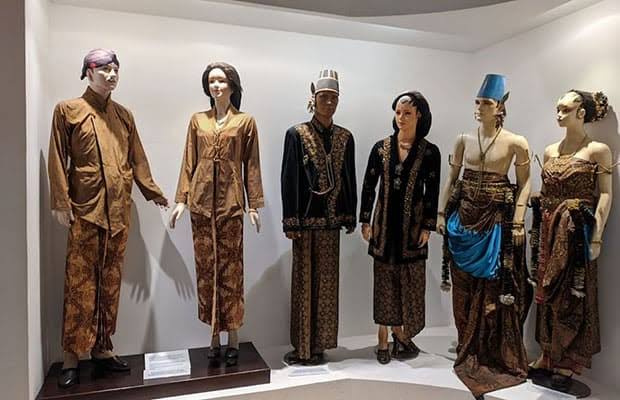
Today, the historical journey of the kebaya can also be explored through museum collections. Some examples are carefully preserved at Museum Sonobudoyo. The garments displayed there reveal how the kebaya evolved over time, reminding us that clothing is not merely something we wear. It is also a record of history and cultural encounters.
In the end, the kebaya tells a simple but meaningful story: while fashions may change with time, the cultural narratives woven into them often last far longer than we imagine.