News
When a Sudden Flood Swept Away an Elephant and Its Keeper: The Legend of Gajah Wong River
East of Yogyakarta City flows a river known as Gajah Wong. For many people, it may simply be part of the urban landscape they pass every day. Yet, according to local legend, its name carries a story about an elephant belonging to Sultan Agung, a royal servant who took over the task of bathing the animal, and a sudden flood that claimed both their lives.
The story is said to have begun when the Mataram Kingdom was based in Kotagede, approximately seven kilometers southeast of present-day Yogyakarta. At the time, the kingdom was ruled by Sultan Agung, who commanded a large military force that included cavalry and elephant troops. The royal court was also served by many loyal attendants who carried out the ruler’s daily affairs.
Among them was Ki Sapa Wira, an attendant known as a srati, or elephant keeper. The elephant under his care was named Kyai Dwipangga. According to the tale, the animal came from Siam and had an enormous body, a long trunk, and gleaming white tusks.
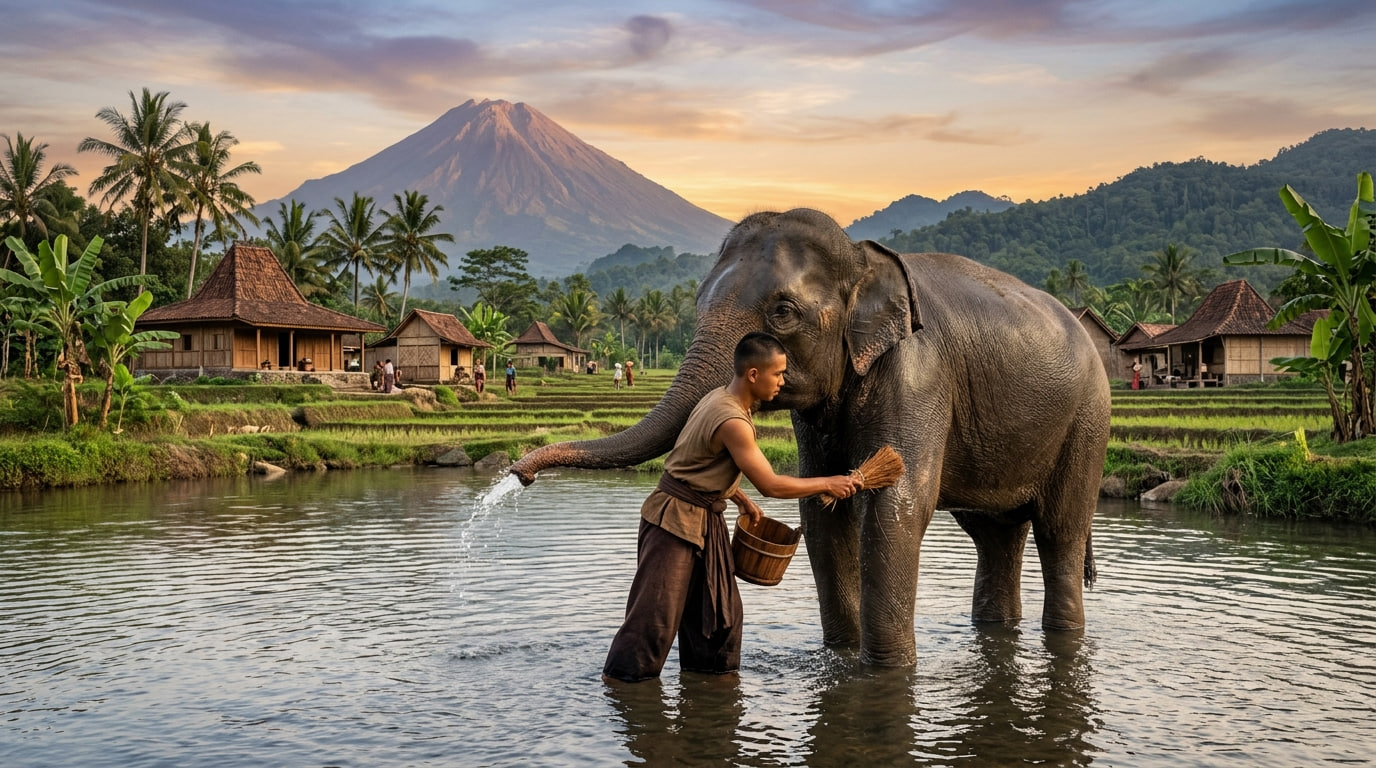
Every morning, Ki Sapa Wira took Kyai Dwipangga to a river near the royal palace for a bath. Through this daily routine, the elephant became accustomed to his presence and gentle treatment. Over time, a familiar bond developed between the keeper and the enormous animal.
One day, however, Ki Sapa Wira developed a painful boil in his armpit. The condition made it difficult for him to move freely, leaving him unable to perform his usual duties. He therefore asked his brother-in-law, Ki Kerti Pejok, to take his place and bathe Kyai Dwipangga.
Ki Kerti Pejok’s original name was Kertiyuda. According to the legend, he had suffered from polio since birth, which caused him to walk with a pronounced limp and an uneven gait. In Javanese, this condition was described as pejok. The term eventually became the nickname by which he was known.
That morning, Ki Kerti Pejok set off for the river with Kyai Dwipangga. He brought two young coconuts to feed the elephant, perhaps hoping the treats would make the animal easier to handle. After all, bathing an elephant of such enormous size could hardly have been an easy task for someone unfamiliar with the routine.
Along the way, Ki Kerti offered Kyai Dwipangga one of the coconuts. The elephant seized it with its trunk and smashed it against a large rock until the shell broke open. It then eagerly ate the contents. The second coconut met the same fate, and the elephant enjoyed its meal once again.
Before Kyai Dwipangga had finished eating the second coconut, however, Ki Kerti ordered it to stand and continue walking. He even struck the elephant’s hindquarters with the whip he carried.
When they reached the river, Ki Kerti instructed Kyai Dwipangga to soak in the water. He began cleaning the animal by rubbing its body with coconut leaves to remove the mud clinging to its skin. Once he believed the job was done, he led the elephant back and returned it to Ki Sapa Wira.
Seeing that his elephant had returned, Ki Sapa Wira asked Ki Kerti for help once more. He hoped his brother-in-law would be willing to bathe Kyai Dwipangga again the following morning.
Ki Kerti agreed to take on the task. Early the next day, he arrived to collect the elephant. The sky looked overcast, but there were no obvious signs that rain was about to fall. Together, they headed toward the river as they had the day before.
This time, Ki Kerti was disappointed to find that the water appeared shallow. He wondered how an elephant as large as Kyai Dwipangga could properly soak in a river with so little water. He therefore led the animal downstream, searching for a deeper stretch.
His complaints began to emerge as they continued along the river. He grumbled that such a small stream was hardly suitable for bathing an elephant. Even as he complained, he continued rubbing Kyai Dwipangga’s back to clean the animal’s body.
Before he could finish grumbling, however, something unexpected happened.
A sudden flash flood swept down from upstream. The powerful surge of water carried away Ki Kerti Pejok and Kyai Dwipangga. Ki Kerti tried to call for help, waving his arms in desperation, but the force of the current was too strong for either of them to escape.
According to the legend, they were swept along the river until they reached the Southern Sea. No one was able to rescue them. Both Ki Kerti Pejok and Kyai Dwipangga eventually died in the disaster.
News of the tragedy reached Sultan Agung. To commemorate the event that had claimed the lives of both a man and an elephant, the sultan is said to have named the river Gajah Wong.
The name combines two Javanese words: gajah, meaning elephant, referring to Kyai Dwipangga, and wong, meaning person or human being. Thus, Gajah Wong River became a reminder of the tragic tale of two lives swept away by the flood.
According to local tradition, the place where Ki Kerti Pejok used to bathe Kyai Dwipangga was located near the area now adjacent to Gembira Loka Zoo in Yogyakarta.
Like many legends passed down through generations, the story of Gajah Wong River is more than an explanation for a place name. It offers a glimpse into life during the Mataram Kingdom, the relationship between royal servants and their ruler, and the way local communities used stories to explain the names of places around them.
Today, Gajah Wong River remains part of Yogyakarta’s ever-changing urban landscape. People cross bridges over it, live along its banks, or simply see it as a river flowing through the city. Not everyone may know the story of Ki Kerti Pejok and Kyai Dwipangga associated with its name.
Yet the legend reminds us that a place name can hold a story far longer than what we see on the surface. Beneath the river’s flowing waters lies a tale of people, animals, disaster, and collective memory that has endured through generations.