News
A Bowl of Soto, a Plate of Pecel, and the World on a Javanese Table
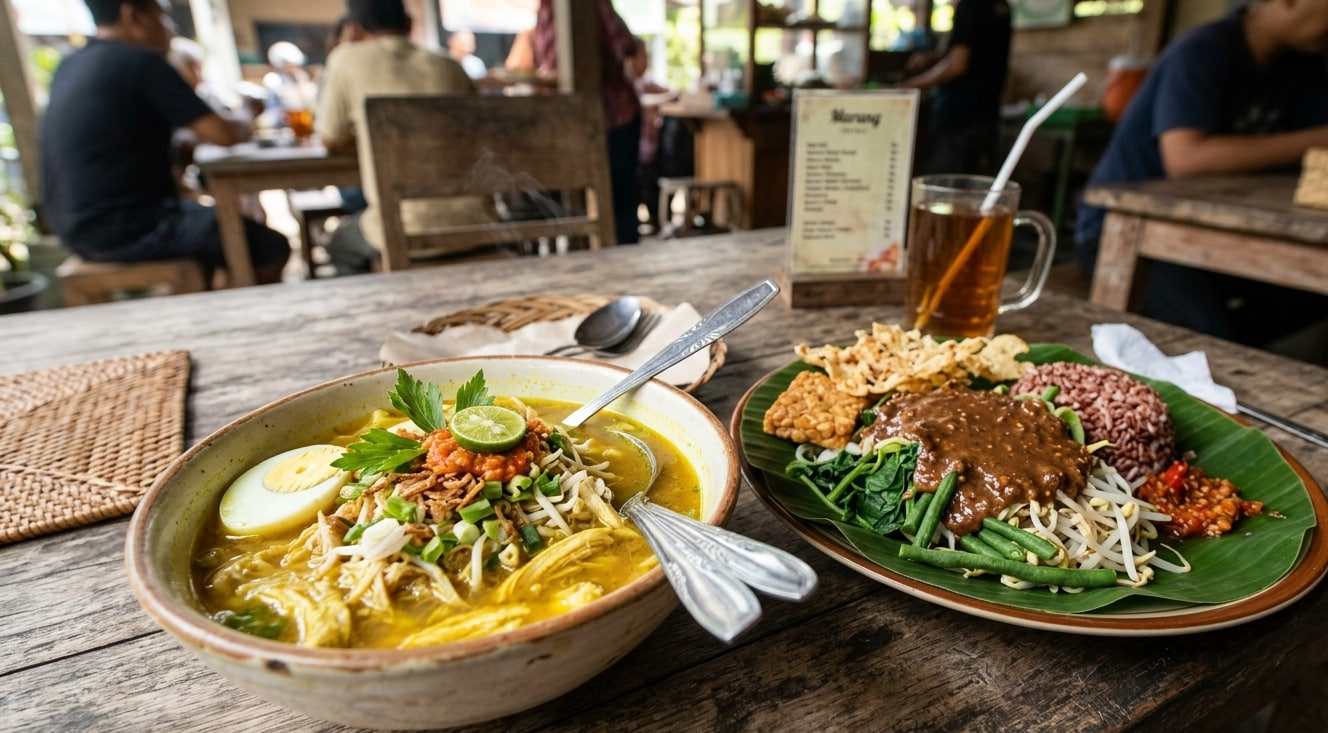
Food often feels local, almost intimate. Yet a bowl of soto carries traces of long maritime journeys. In Nusa Jawa: Silang Budaya 2, historian Deny Lombard describes soto as part of the cultural exchanges between Java and the Chinese world. He notes two early dominant styles chicken soto and tripe soto though today the variations seem endless.
Regarding the word’s origin, Lombard refers to the term “caodu,” associated with cooked animal offal. From this, some suggest the word “soto” emerged. However, this interpretation has been questioned. In 2020, Aurelia Vizal argued that Mandarin was unlikely to have been the linguistic source during the seventeenth century, when soto first appeared in Java. Many Chinese migrants to the archipelago came from southern regions and spoke different dialects.
An alternative theory points to the Hokkien dialect, suggesting a word sounding like “tacauto,” loosely associated with carrying a portable kitchen table. This becomes intriguing when we recall that soto was traditionally sold by vendors carrying shoulder poles. The inheritance, perhaps, was not only culinary but also commercial practice.
Brongkos tells another story. Thick and dark from coconut milk and keluak, enriched with black-eyed peas, tofu, beef, and aromatic spices, it feels deeply rooted in Yogyakarta. Yet the presence of black-eyed peas reveals global ties. According to Encyclopedia Americana volume 8: Corot to Desdemona, this crop has been cultivated for thousands of years, with debated origins ranging from Africa to Iran and India. By the seventeenth century, it had reached the Caribbean and North America. Through centuries of trade and exchange, it eventually found its way into Southeast Asian kitchens.
Pecel, on the other hand, appears to be far older within Java itself. Historical indications suggest that vegetables served with thick sauce were known as early as the tenth century. The Prasasti Siman from 943 CE, dating to the reign of Maharaja Sindok, contains descriptions interpreted as referring to such dishes. Mentions also appear in the Kakawin Ramayana and later in the Babad Tanah Jawa.
On a Javanese dining table, then, lies a small map of the world: soto with possible Chinese echoes, brongkos shaped by crops that once traveled across oceans, and pecel rooted in a millennium of local memory. We eat them casually. Yet each bite carries stories of migration, language, trade, and adaptation. The kitchen, it turns out, has always been more cosmopolitan than we assume.