News
Mantrijeron: A Name That Carries Layers of History in Southern Yogyakarta
In today’s Yogyakarta, Mantrijeron refers to more than just one thing. It simultaneously names a neighborhood, a street, a kalurahan, and a kemantren—the local term used in Yogyakarta for an administrative unit equivalent to a district. Few place names carry such layered identities, and Mantrijeron is one of them.
The origin of the name lies in a soldiers’ settlement. Mantrijeron was once home to abdi dalem prajurit of the Yogyakarta Sultanate, specifically those belonging to Bregada Mantrijero, also known as Mantrilebet in formal Javanese. Literally, Mantrijero means “ministers within the palace”, reflecting their close association with the royal court.
From Inside the Fortress to Beyond the Walls
Geographically, Kampung Mantrijeron lies east of Mangkuyudan and north of Jagakaryan. The name Mantrijeron became established during the reign of Sultan Hamengkubuwana IV (1814–1823). Prior to that period, Mantrijero soldiers lived inside the fortified palace complex, an area known as Njeron Beteng.
During Sultan Hamengkubuwana IV’s rule, royal soldiers were relocated outside the palace walls, to areas referred to as Njaban Beteng. This shift marked a significant moment in the spatial and social organization of the Sultanate, giving birth to Mantrijeron as a distinct soldiers’ quarter beyond the fortress.
Disbanded and Revived
Bregada Mantrijero was among twelve palace military units disbanded in 1942 under political pressure from the Japanese occupation government. For years, these units existed only in memory.
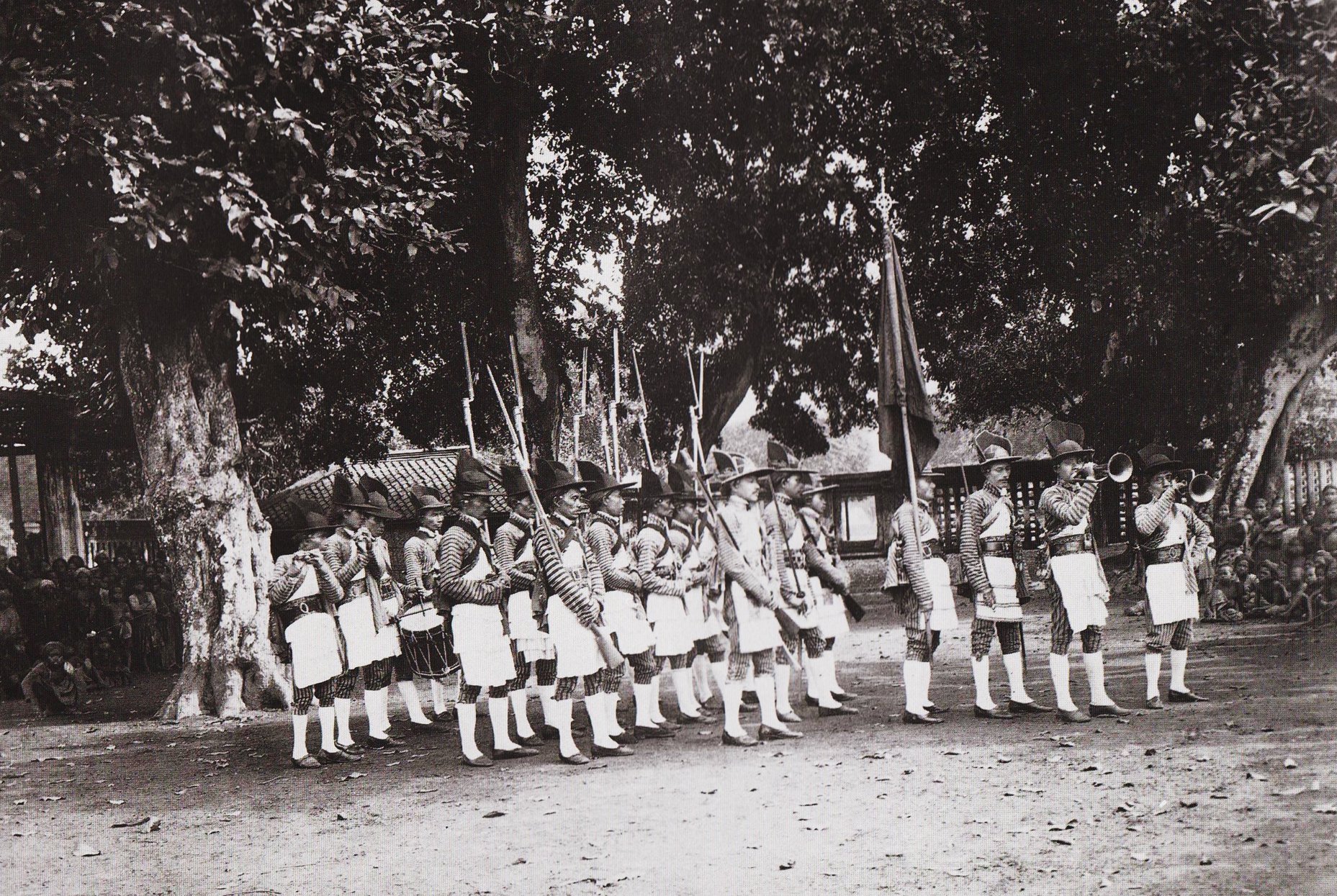
That changed in 1970, when Sultan Hamengkubuwana IX reactivated ten of the palace brigades, including Mantrijero. Notably, their uniforms were restored exactly as they had been before 1942: full lurik attire, a white inner shirt, and a black cap featuring a horizontal brim at the front and a vertical brim along the back.
Elite Guards of the Sultan
Historical records from the Sultanate describe Mantrijero as an elite unit. During major ceremonies such as a Sultan’s coronation, two Mantrijero soldiers armed with kelewang swords were assigned as the closest guards to the Sultan and the Queen Consort, standing at their left and right throughout the procession.
They moved in formation with eight Nyutra soldiers carrying spears, who marched several steps ahead. This arrangement was also used during the colonial period, including Grebeg ceremonies attended by Dutch officials. Such scenes were famously captured in photographs by Kassian Cephas, particularly during the reign of Sultan Hamengkubuwana VII.
Thus, Mantrijeron is far more than a name on a map—it is a living trace of palace soldiers, royal rituals, and the long history of power in Yogyakarta.