News
Pepatih Dalem of Yogyakarta: A Powerful Position Between the Palace and Colonial Rule
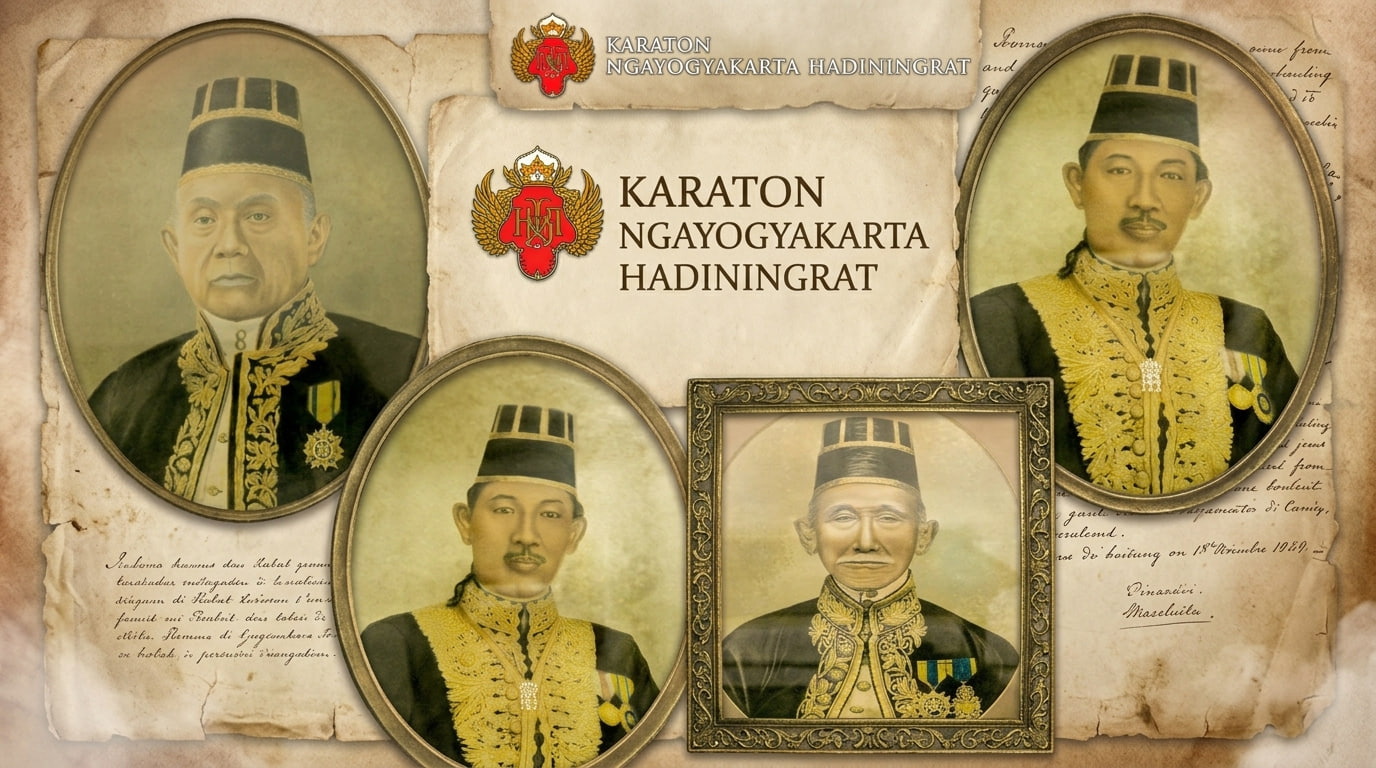
In the history of the Yogyakarta Sultanate, the Sultan was not the only figure responsible for running the kingdom. For centuries, an important position known as Pepatih Dalem played a major role in the administration of the palace. Roughly comparable to a prime minister, the Pepatih Dalem assisted the Sultan in governing the sultanate while also serving as a link between the palace and the colonial authorities.
The position emerged as part of the political structure of the Yogyakarta Sultanate following the Treaty of Giyanti in 1755. The treaty divided the Islamic Mataram kingdom into the Yogyakarta Sultanate and the Surakarta Sunanate. Along with the political traditions of the former Mataram kingdom, the institution of the patih was also inherited.
Yet the position was never entirely straightforward. The Sultan relied on the patih to manage the daily affairs of government, while the colonial authorities also had their own interests in the position. Political contracts between the Sultan and the colonial government regulated the role of the patih. As a result, the Pepatih Dalem often stood between two different centers of power: the interests of the palace and the demands of the colonial administration.
Danureja I and the Beginning of the Pepatih Dalem Tradition
The first person to hold the position was Kanjeng Raden Adipati Danureja I. In his youth, he was known as Raden Bagus Konting Mertowijoyo and was the son of the Regent of Banyumas.
He had been sent to serve at the Kartasura Palace from an early age, where he became a close companion of Raden Mas Sudjono, later known as Prince Mangkubumi and eventually Sultan Hamengku Buwono I. Their relationship went beyond personal friendship. Danureja I supported Mangkubumi during his struggle against the VOC.
After Mangkubumi became Sultan of Yogyakarta, Danureja I was appointed as Pepatih Dalem. He served from February 13, 1755, until his death on August 19, 1799. His close relationship with the Sultan was once compared by VOC Governor Hartingh to the relationship between a kris and its sheath—two separate elements that work together as one.
The Patih and the Struggle for Political Influence
Danureja I was followed by a succession of patihs whose political backgrounds and loyalties varied. One of the most controversial was Danureja II, who became known for his close relationship with the Dutch colonial authorities.
His political alignment contrasted sharply with that of Sultan Hamengku Buwono II, who strongly opposed Dutch influence. As tensions grew, Danureja II was removed from office by the Sultan, although Daendels later restored him to the position. His tenure eventually ended in 1811 when he was killed on the Sultan's orders.
His story demonstrates that the Pepatih Dalem was far more than an administrative official. The position was deeply connected to the political struggle between the palace and colonial power.
The next major figure, Danureja III, also maintained strong ties with the Dutch. His policies concerning taxes and toll gates angered Prince Diponegoro. In the broader historical context, these policies contributed to the growing tensions surrounding Yogyakarta before the Java War erupted in 1825.
From Politics to Literature and the Arts
Not every Pepatih Dalem was remembered solely for political affairs. Several also contributed to literature and the arts.
Danureja V, for example, served during the reconstruction of the Tugu Golong-Gilig after the monument was damaged by the 1867 earthquake. During his administration, several literary works concerning the history of the Yogyakarta Sultanate were also produced, including Serat Pustaka Jatya and Serat Babad Mataram.
Danureja VI was likewise associated with written works such as Kempalan Kitab-Kitab Islam and Serat Betaljemur Adammakna. He also had a grandson who would later become known as Ki Ageng Suryomentaram, a prominent Javanese thinker and spiritual figure who eventually abandoned his princely title.
Another fascinating figure was Danureja VII, who had a strong interest in performing arts. Before becoming Pepatih Dalem, he was known as Kanjeng Pangeran Haryo Yudanegara III. He developed Langen Mandra Wanara, a form of wayang orang that brought palace-style performance beyond the walls of the royal court. Its distinctive features included performers dancing in a squatting position while delivering dialogue through sung verses.
He was also associated with the creation of Gamelan Beling, whose instrument blades were made from pieces of glass. His activities demonstrate that the palace administration was not merely a political institution but also an environment where artistic and cultural creativity could flourish.
Danureja VIII and the End of the Patih Position
The final holder of the Pepatih Dalem position was Danureja VIII, formerly known as Kanjeng Raden Tumenggung Harjokusumo. He was inaugurated in Batavia on November 30, 1933, and became the last patih of the Yogyakarta Sultanate.
Unlike several of his predecessors, Danureja VIII lived during a period when access to modern education was expanding. He received education in the Netherlands and had a background in political studies.
His tenure ended in 1945. Afterward, Sultan Hamengku Buwono IX took the significant step of abolishing the Pepatih Dalem position from the governmental structure of the Yogyakarta Sultanate.
The decision was more than a simple administrative reform. Throughout its history, the patih position had served two functions. On one hand, the patih was the Sultan's chief assistant. On the other, the position also served as an important channel of communication between the palace and the colonial authorities.
When Japanese rule replaced Dutch colonial administration, Sultan Hamengku Buwono IX saw an opportunity to reshape this system. By eliminating the position, the Sultanate's government could be brought more directly under the Sultan's authority.
The Historical Legacy of the Pepatih Dalem
The Pepatih Dalem position no longer exists within the governmental structure of the Yogyakarta Sultanate. Nevertheless, its history offers an intriguing picture of how a Javanese kingdom maintained its political system while facing pressure from foreign powers.
From Danureja I to Danureja VIII, each figure left behind a different legacy. Some were remembered for their loyalty to the Sultan, others for their connections with colonial authorities, while others became involved in political conflicts or contributed to literature and the arts.
For this reason, the history of the Pepatih Dalem is more than a list of names and dates. It tells a broader story about politics, competing interests, cultural development, and the transformation of Yogyakarta through different historical periods. Although the position eventually disappeared, its legacy remains an important part of the long history of the Yogyakarta Sultanate.


